Construction Information
When designing No 2 (and building 'Alice') I found it very useful to see how others had approached practical problems, like suspension, valve gear, pony trucks etc..
One of the most useful books I have found is Henry Greenly's Model Steam Locomotives, on whose information all the calculations for 'Alice' were based - and have proved very good in practice.
FRAME THICKNESS
D2 x S x P = Tractive Force in lbs where D is the cylinder bore (in inches), W is wheel dia., S is Stroke and P is boiler pressure (80%)
Wheels are best made from EN8 steel
L2 + X2 = Radius
I use this formula when building points to set out the radius, as one never ever has room to do it with a bit of string! It makes it a very quick and easy process to check you've rolled the rail correctly.
It must be said, that adherance to the exact dimensions of the wheels is not ultimately critical - except for the back to back dimension (which, if incorrect will inhibit running over 'fine scale' point work).
Also, if the flange depth is too great, the flanges may hit and ride over fish plate bolts.
RADIAL TRUCKS
Radial trucks are a very useful alternative to the normal "Bissell" type pony truck that we are so used to.
Their value is in when there is insufficient space for the 'A' frame and pivot.
Essentially, they are very simple (and very effective) - one of the complications being fitting the springing in - this Greenly
drawing shows the axle in axle boxes tied together within the sprung radial truck, whereas 'Alice' has a cannon axle,
with radiused bearing housings (doing the radius bit...) with a sprung plate pushing down on the whole lot.. (the sprung plate doesn't
move sideways with the radial truck, it simply goes up and down....)
The mistake I made was in making 'Alice's radial truck too good a fit to the plates it has to slide in.
It moved side-to-side beautifully, but if I lifted just one wheel up, it all locked up solid.
I then had to grind away enough metal to allow the truck to move up and down, side to side, and twist - all freely.
Therefore the end result is a sloppy fit (which is correct for this type.). However, done The same way as Corris No 3, you don't need the sloppy fit, as the radial frame doesn't have to twist in the mainframe.
Incidentally, I made 'Alice's truck and frame unit as an entirely separate componant, which I just bolted in to the main-frames.
BALDRY's RULE - how to work out where your pony-truck pivot should be....
VALVE GEAR
Slide Valves - (Ports) dimensions in inches, as prescribed by Henry Greenly
D = diameter of cylinder
W = 1/2D + 1/16
BOILER CONSTRUCTION
SUSPENSION
Most of these examples show the use of (modified) Take-up bearings. These are normally used for the tension adjustment on conveyor belts, but are very suitable for our applications, being cheap (see my links page), self aligning, and ready to mount.
MISC.
updated 19th Nov 06
These are some reference photos that loco builders may find useful. If anyone would like to send me some to include for other peoples benefit - please do!
Henry Greenly recommends frames (in 10 1/4") to be 1/4" of 5/16" thick. This is one of the very few areas I might slightly disagree
with him on (although his loco's are many and very successful....)
My own experience showed that 'Alice's' frames, at 6mm were too flexible, and I chose to weld stiffeners in
(which have been getting in the way ever since.....). I would suggest that 8mm was the minimum thickness, and preferably 10mm
for a loco of any gravitas. 'The Priest' has frames 12mm thick, and Exmoor build their locos with frames 15mm thick!
Pick your choice, but gone are the days when you had to chop the frames out with a hacksaw.....
W
2X

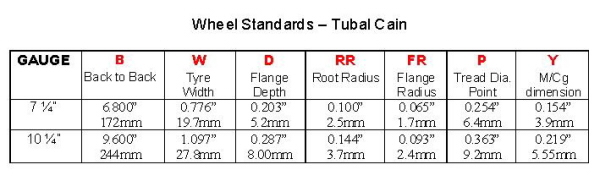
Most commercial miniature railways running narrow gauge stock tend to use a much coarser profile than these given - even reducing the back to back dimension.
In smaller scales, some builders have flat treads, instead of with the two degree coning. With regular running, this leads to greater flange wear - therefore it is much better to have the correct profile.

As you know, the standard pony truck has a pivot, the position of which is defined by Baldrey's rule.
The principle of the radial truck is to synthesise the travel characteristics of the pony (or Bissell) truck without actually having
the pivot or 'A' frame.
This is achieved by mounting the axle in a frame (the radial truck itself),
with curved front and back faces (curved the the radius of where the pivot would be...).
The main frames have similar curved faces to them, so when the axle is pushed to one side by the curvature of the track,
the radial truck forces the inside wheel rear-wards, and the wheel on the outside of the curve forwards.
The third way is like Corris No. 3, where the radial frame is unsprung, and only moves sideways. The springing being achieved conventionally within the radial frame.
........You can fit side control springing or not as you wish.


Corris No.3. This is just the radial truck without the main-frames (obviously...)
Outside of 'Alice's radial truck. Note the inset frame to allow side travel.
A rather poor photo of 'Alice's radial, used and abused......
The red springs bear down on a plate which in turn bears down onto the to of the cannon axle.

Drawing showing 'Alice's Radial truck

L = Piston stroke
W = Width of ports
P = Length of ports
E = Length of exhaust port
B = Thickness of port bar
P = L/16
B = 5L/64
E = L/8
 'Pulborough's simple and very effective pony truck (Exmoor)
 The external regulator (ball valve)
 Loco under construction (Exmoor)
 Two tubes extracted from working boilers. The clean tube was in use for 10 years with proper water testing and treatment, the badly scaled tube only survived two years after using water straight from the tap.......
 fabricated grate
 inside an Exmoor firebox - with the all important fusible plug
 Steam feed to the cylinders
 Exmoor smokebox with washout plug
 Full size spring compensating beam
 Inner fire boxes under construction at Exmoor
 Fire box tube plate
 Fire box tube plate showing foundation ring
 Leading axle suspension at Exmoor - 10 1/4"
 Pony truck detail
 springing at Moors Valley - NB these sprung beams are on both sides of each frame. 7 1/4"
 Tender suspension Ravenglass & Eskdale 15" gauge
 Leaf springs at Festiniog Railway
 Pony Truck with swinging links on Welsh Highland monster
 Springing on 'Isambard Kingdom Brunel' - 10 1/4"
 Pony truck - Moors Valley 7 1/4"
 Moors Valley typical motion - 7 1/4"
 Machined crossheads at Moors Valley
 Cylinder and Crosshead at Exmoor - 10 1/4"
 Cylinders at Exmoor
 'Isambard' at the Royal Victoria Railway - 10 1/4"
 Motion at Moors Valley
 Motion at Moors Valley
 Fly crank at Exmoor- slotted using very fine cutting disc in an angle grinder - 10 1/4"
 Cylinder and slide bars at Exmoor Cylinder and slide bars at Exmoor
 Inclined plane springing of pony truck - Moors Valley
 Front end under construction
 External ball valve regulator and steam pipe (plus top feed)
 'Alice' undressed - note smokebox is a continuation of the boiler barrell - 10 1/4"
 'Alice's simple springing
 'Alice's fabricated smokebox saddle (10mm plate) - 10 1/4"
 Method of feeding steam oil to the valve chest - note non return valves at BOTH ends of oil pipe - 10 1/4"
 'Alice's Tender bearing and springing - 10 1/4"
